

The 2010 Australian Election is going to be an interesting one for social media analysis, because for the first time we will see to be able to see whether social sentiment is going to have an impact on how people vote. I started looking at this on Friday 16 July, the day before the election was called, and left the social media monitoring tool looking at the same keywords over the weekend which included the day of the election announcement.
This analysis is from 1 to 18 July and includes mainstream media as well as strictly “social” media channels. Twitter has by far the largest volume of mentions for both parties.
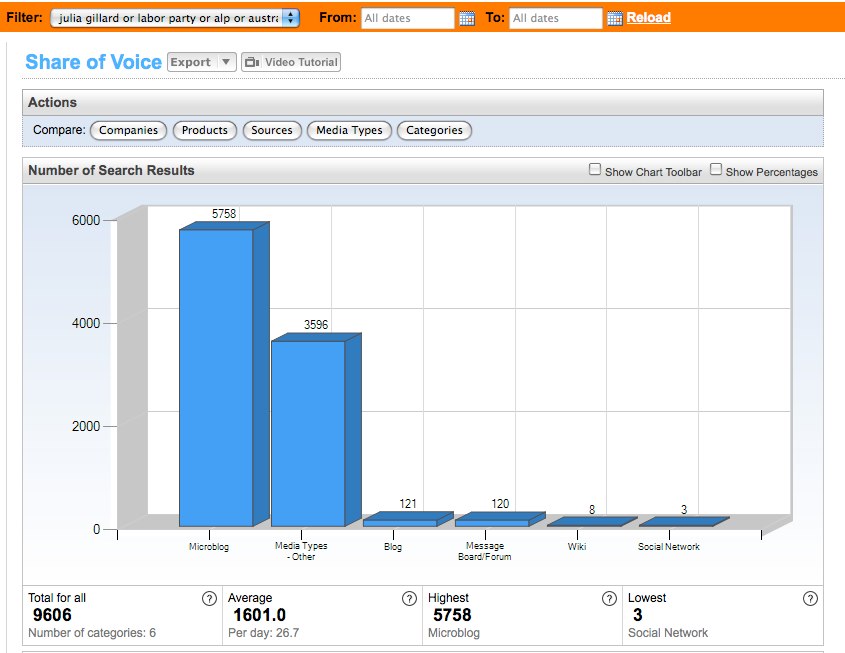
Australian Labor party mentions by social media channel
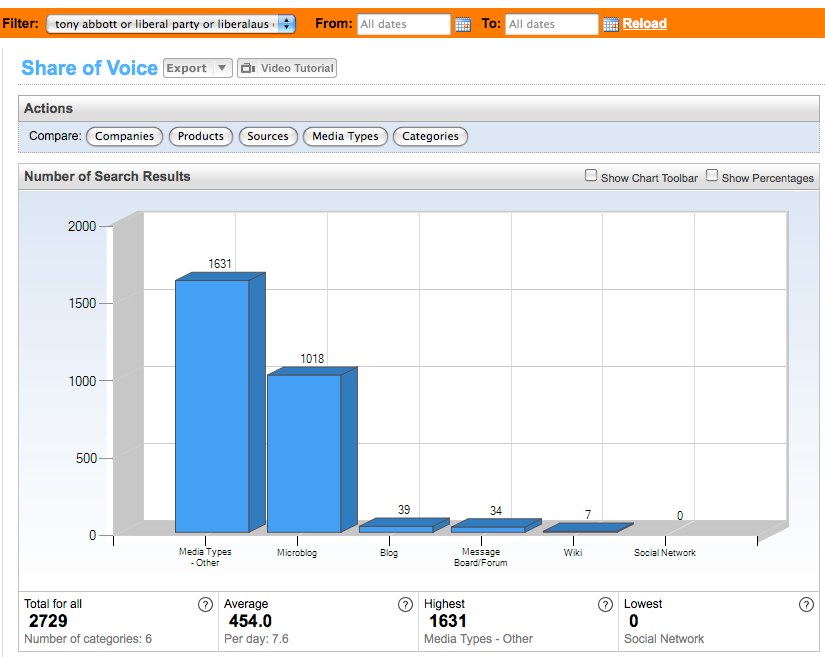
Australian Liberal party mentions by social channel
To see the impact social media has on volume, look at the day that Julia Gillard started tweeting. It caused a spike almost as large as the day the election was called when you look at all media, but on Twitter itself, had more interest/volume than the election announcement.
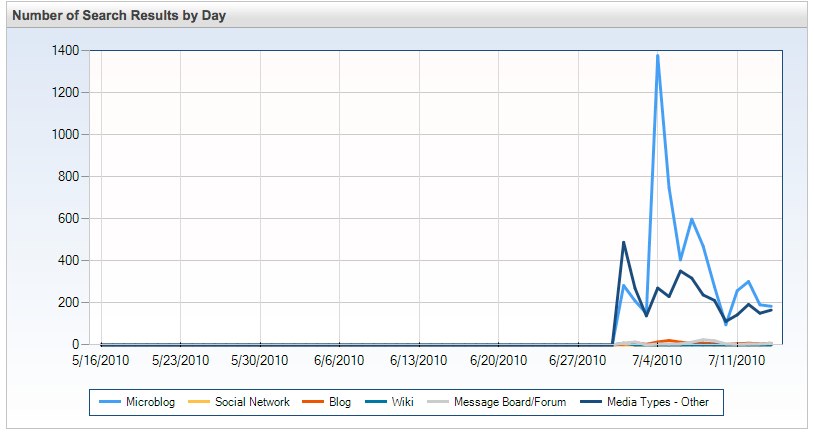
Labor Party social channel mentions over time
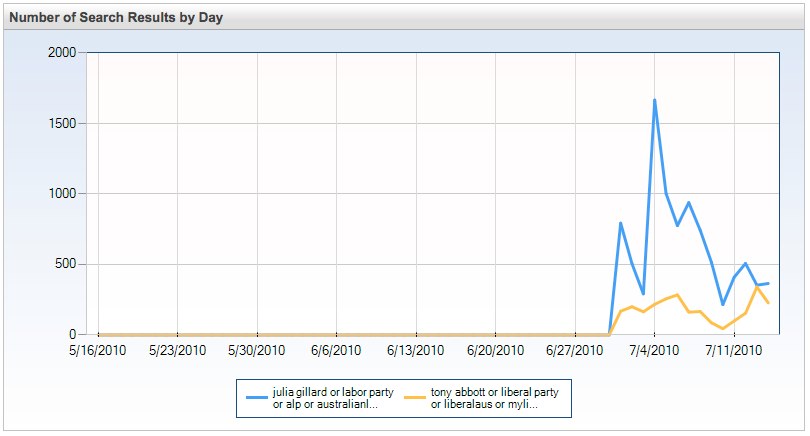
Impact of Julia Gillard joining Twitter on volume of mentions
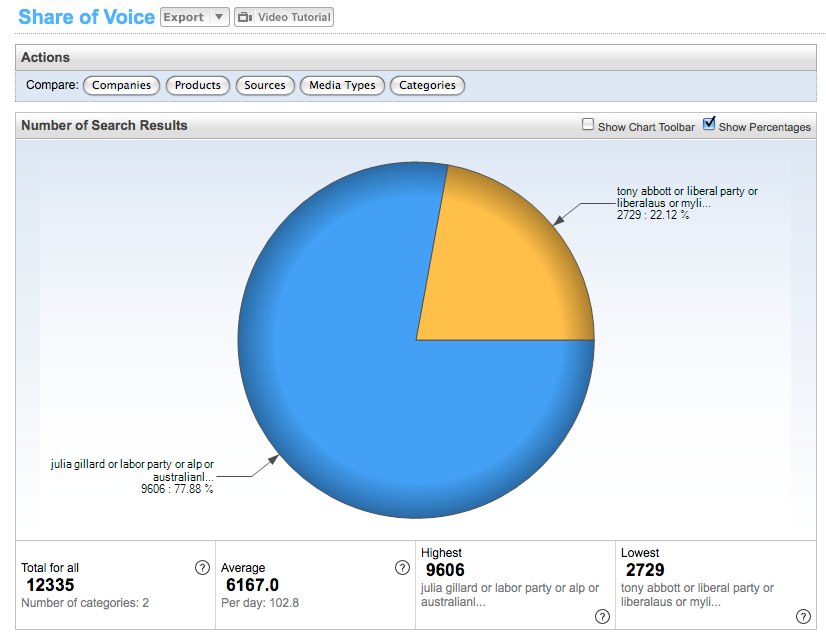
Liberal vs Labor share of voice
Net Sentiment score: Liberal Party in front
On Friday, the share of voice was dominated by Labor with 78% of conversations about Labor or Julia Gillard and 22% was for Liberal or Tony Abbott (for Australian domains only, I didn’t have enough time to run a US and AU inclusive search).
By the end of Sunday, even though the numbers had spiked massively in terms of the volume of conversation, and even with US domains included in the search, the share of voice had moved only 1%, 77% Labor to 23% Liberal. I also ran a sentiment score analysis on Friday and again post election announcement.
Pre-election announcement:
(1 is positive so both have a negative score)
- Labor net sentiment 0.67
- Liberal net sentiment 0.74
Post-election announcement including US domains
(1 is positive so both have a negative score)
- Labor net sentiment 0.67
- Liberal net sentiment 0.70
So Liberal sentiment is going down and Labor’s is steady. It will be interesting to keep watching this score to the election. I haven’t looked at the entire “landscape” of the wider election sentiment in this analysis so the Greens and other parties issues are not included here, just the 2 major parties.
Analysis of Liberal & Labor social media efforts
There’s poor form overall from both Liberal and Labor. They’ve both set up social channels but use them to broadcast messages just like they do in traditional media channels, and they let the emergent community monitor itself. Spam is a problem in Facebook for the Liberal Party (not that they do anything about it).
There are huge missed opportunities to respond to issues in social channels. Neither party is responding in any channel to the huge volume of discussion. They may or may not be monitoring the issues, but given the extremely negative sentiment regarding internet filter, and immigration policy and boat people, the Government could at least be pro-actively addressing these issues.
Here are the breakdowns
Australian Labor Party
Website
Newly relaunched site has 2 places for social engagement
–it’s a public forum – the main barrier to entry is that people must register
–can’t login with Facebook, Twitter OpenID or any other “social identity”
–people can give ideas for policy
–Blog is more an article feed – users can’t comment
–Interactive game – “Tony Abbott Hospital Cuts” game
Australian Labor
https://twitter.com/AustralianLabor
1,680Following1,638Followers
Joined 10 December 2009
Ratio:
Good following to followers ratio- they are making an effort to follow back everyone who follows them – best practice
Hashtags:
- ALP Use of hashtags is not as smart as it should be. Inconsistently used, inconsistent naming, and too generic.
- For example, tweets marked with #news and #blogs too generic and does not enable people to search for specific ALP topics relevant to them
- Only started using specific hashtags Friday 16 July related to their 2 community forums #Thinktank and #LaborConnect
- Again #ThinkTank could be anyone’s think tank and does not identify it as ALP. Should be #ALPThinkTank to make it work harder for them
- Use Twitter lists as a way to track MPs but only one list
Content:
Not conversational at all – use it to broadcast blog article links, official announcements.
Prime Minister Julia Gillard
https://twitter.com/juliagillard
9,389Following20,752Followers
Joined 27 October 2009 but only tweeting since July 4, 2010
Ratio:
Decent follower to following ratio, would say that since she’s been PM that it’s difficult to get the auto-follow to keep up with the amount of people following her each day
Content:
Strictly broadcast
Tweet content is partly first person, partly third person. Inconsistent tone suggests her account is managed by different people but there’s no transparency on who’s tweeting on her behalf.
Julia Gillard
https://www.facebook.com/pages/Julia-Gillard/161674172327
32,651 People Like
Australian Labor
https://www.facebook.com/LaborConnect
1,620 People Like
Facebook commentary is raging on every article or status posted in Facebook on Julia’s page but no official voice is responding.
The community is talking to itself here, on the wall, discussion board, but there is no input from the people running Julia’s page.
The community is left to run and moderate itself – not best practice
Minimal/no spam so the pages seems to be monitored but no responses back from anyone running the pages.
YouTube
https://www.youtube.com/user/australianlabor
Subscribers 1504
72 Videos
Channel Views: 185,685
Total Upload Views: 765,591
Style: Broadcaster
Joined: June 10, 2007
Australian Liberal Party
Website
- has “support”, “comment” and “like” social interaction features on the “Our Ideas” section of their website
- “Our Ideas” as a name for this section does not suggest that feedback is elicited (i.e. they are Liberal Party ideas and they aren’t interested in your ideas) or wanted and as a consequence doesn’t have a lot of responses
Liberal Party
https://twitter.com/LiberalAus/
3,801Following4,261Followers
Good following/followers ratio
Joined 4 April 2009
Content:
- Strictly broadcast but well written tweets
- Links to news content articles on Liberal website
Hashtags:
- Easily identifiable and consistent use of hashtags
- #myliberal and #ausvotes on every tweet.
Tony Abbott
https://twitter.com/TonyAbbottMHR
20Following10,950Followers
Joined
Poor following ratio – doesn’t follow people back
Content:
Broadcast. Not conversational
Personal content with photos and descriptions, mixed in with jabs at the government and then also Liberal policy announcements.
https://www.facebook.com/LiberalPartyAustralia
6,751 People Like This
https://www.facebook.com/pages/Tony-Abbott/216342268645
7,920 People Like This
Both these pages have Facebook spam (people linking to off topic or personal pages) suggesting its not viewed or monitored very well.
YouTube
https://www.youtube.com/liberalpartytv
74 Videos
Subscribers: 6
Channel Views: 20,985
Total Upload Views: 230,283
Joined: September 28, 2008
Summary
Neither Liberal nor Labor parties are responding in any of the social channels – they are too busy “broadcasting” messages and leaving the communities to manage and moderate themselves. The debates are raging (on and off topic) in Facebook and Twitter, but with no official responding voices in any party channels. The only minor benefit is that the parties are taking the political messages into the social spaces where the voting public spend the majority of their time online.
What do you think? Would the political party that addressed the issues in social spaces get any brownie points going into this election?

15 Comments
[…] This post was mentioned on Twitter by Tiphereth Gloria, Tiphereth Gloria and Chris Quinn, Resolute Associates. Resolute Associates said: Very interesting RT @tiphereth: #aus2010 – social media match fitness https://bit.ly/c8S4c5 #ausvotes #0zelections […]
[…] the rest of this great post here Comments (0) Posted in Election Politics […]
[…] the rest of this great post here Comments (0) Posted in Election Candidate […]
[…] Digital Tip » Australian Election 2010 – social media match fitness: […]
Hey Tip,
Some interesting findings here. What monitoring tool are you using – it looks rather pretty.
C
Hi Carl, I use Alterian SM2 – and these aren't event the pretty graphs, just the standard ones! There's a lot of flexibility with it and you can export the data and DIY charts too.
[…] here is an early anlysis on the use of social media by the two leaders and here is an even more detailed election 2010 social media analysis including charts and […]
I think it would be quite in line with Gillard's “Moving Forward” motto if she utilised the strengths of new media beyond simply broadcasting campaign messages!
From the graphs that you've shown, it looks as though there is enough interest online to see what both candidates are willing to do with their social media presence. I definitely think that the political party more willing to address issues within the social arena will win more brownie points with voters. It could make them appear more transparent, approachable and in touch with their constituents if this is managed well.
The exciting part is seeing if anyone is up for the challenge and whether their social media strategies develop over the course of the election. Welcome to Election 2.0!
[…] consensus. Mumbrella says “This is not going to be an Obama-style social media-led uprising”. Tiphereth Gloria recently published a detailed analysis of the relationship thus far, noting that “There’s poor […]
[…] of election material -as this kind of staggering infographic , again from Digital Tip, shows, the election announcement spurned less activity on Twitter than Julia Gillard getting a Twitter acco… (scroll down a bit for the diagram). What is largely happening right now is that Twitter users are […]
Disappointing that both parties are broadcasting linearly instead of taking advantage of the back and forth of true social media, an incredibly potent political tool. I have no doubt parties would earn brownie points for directly weighing in on these online debates. They have the potential to sway fence sitters with a community management strategy.
I produced some of the Kevin07 videos for YouTube. Rudd was lauded at the time for the innovation, despite following directly in Obama's campaign. But unlike Obama, communication moved in only one direction. The only responses Rudd gave were the typical bitchy political baiting marring Australian politics. We don't want to hear schoolyard arguments, we want to hear our questions answered.
Vibewire has launched a great youth election reporting platform in collaboration with Google called ElectionWIRE. They have reporters on the ground in capital cities posting YouTube videos and blog posts on the election. Another forum offering politicians a feel of the pulse they'll undoubtedly ignore.
Thanks for your comment Leshanne. I agree – if there were active and relevant responses from either Party in social channels we would feel that they were listening to us rather than talking at us. Nearly a week after my analysis, there has been a minor effort from Labor Connect to respond via Facebook and Twitter. It seems very tokenistic (i.e. only 1 or 2 @replies a day and one or two responses in Facebook) considering the huge volume of comments raging. Still better than Liberals who continue to ignore everything that's going on. Let's see what happens next!
It will have a massive impact. From my perspective Twitter took Rudd out. All the journos were desperate to get rid of him so they could go to bed. That made it seem like a fait accompli…. and then it was:)
[…] 2010 Social Media Fitness This entry was posted in background research and tagged Facebook, Greens, Obama, politics, Read Write Web, social media, Twitter. Bookmark the permalink. ← Debut post […]
[…] see is that we’re aiming for mass appeal just like politicians are too. Aussie candidates were broadcast with minimal discussion and Toronto mayoral candidates were going through the motions. Avoiding offense in our tweets means […]